Stop Waiting for the Perfect Team. Become the Person Who Can Move the Work Forward
The Spark
There is a major difference between being good at your job and being able to take an important problem from beginning to end.
You can be excellent at strategy but struggle to turn a plan into something real. You can be a strong executor but need someone else to tell you what the right problem is. You can communicate well, organize projects, and hit deadlines, yet still depend on several people before an idea can move.
Position Yourself Before the Fed Moves
The Fed’s anticipated rate cut this fall isn’t just about cheaper money - it’s about where that money flows first.
Our 10 Best Stocks to Own in 2026 report spotlights the companies positioned to benefit most when the Fed makes their move.
These are high-quality, well-capitalized industry leaders…
From AI powerhouses to reliable dividend growers - all vetted by MarketBeat’s analysts.
This report is free as of today.
After that, it’s only accessible behind a paywall.
Get the full list of names before the move begins.
What makes an end-to-end operator different
The most valuable operators increasingly sit between those extremes.
They can look at an unclear situation, figure out what matters, form a reasonable direction, and start building toward an outcome. They do not need every variable resolved before taking the first step. They know when to zoom out and think strategically, and when to zoom in and personally do the work required to make progress.
That is what makes an end-to-end operator different.
The person who does not stop at the idea
Imagine you have an idea for a new content series at work.
One person writes down the concept, explains why it could work, and waits for a designer, writer, video editor, subject-matter expert, and leadership team to determine what happens next.
Another person takes the same idea and starts turning it into something tangible.
They draft the first script. They record a rough version. They edit a simple prototype. They create an example of how the content could appear on the company’s social channels. Then they bring that prototype to the people who need to approve it.
The second person has changed the conversation.
Instead of asking people to imagine an idea, they have given everyone something concrete to react to.
That matters because ideas are cheap when they remain abstract. Execution creates information.
A rough prototype can reveal that the concept is stronger than expected. It can expose a flaw before significant resources are committed. It can generate questions that were impossible to identify during planning. It can also make approval easier because decision-makers can see what they are actually being asked to support.
The end-to-end operator understands this instinctively.
They do not confuse “this is not technically my responsibility” with “this problem is not worth solving.”
Tip: When an idea is difficult to explain, build the smallest realistic version that allows someone else to see it, test it, or challenge it.
Strategy and execution should not live in separate worlds
Many people become comfortable operating at only one altitude.
At 10,000 feet, they can discuss goals, priorities, customers, markets, and long-term direction. But when it is time to translate those ideas into actual work, they hand the problem to someone else.
At ground level, others are excellent at completing tasks but may not understand why the work matters, what trade-offs are acceptable, or what should happen next.
End-to-end operators move between both levels.
They can ask, “What are we actually trying to accomplish?” Then they can follow that question with, “What needs to happen this afternoon to move us closer?”
That shift is important because strategy without execution remains a proposal, while execution without strategy can produce a large amount of activity without much progress.
The ability to move between the two also improves decision-making. When you understand the details of execution, your strategy becomes more realistic. When you understand the broader objective, your execution becomes more purposeful.
This does not mean doing every task personally forever. It means understanding enough of the work to connect the decision with the result.
You should be able to recognize what is feasible, identify what requires specialist help, explain the requirements clearly, and determine whether the final output actually solves the original problem.
Tip: Regularly switch between the question of “Where are we going?” and “What would I actually have to do to get there?”
Ownership means reducing the distance between you and the outcome
A narrow view of responsibility asks, “Who owns this task?”
An ownership mindset asks, “What is preventing the outcome from happening?”
Those questions produce very different behavior.
If a project is blocked because nobody has created the first draft, an end-to-end operator may create it. If the problem is unclear requirements, they clarify them. If the team needs outside expertise, they find it. If two groups have competing incentives, they work through the tension rather than allowing the disagreement to quietly freeze the project.
This does not mean ignoring organizational boundaries or stepping on other people’s responsibilities. It means refusing to use those boundaries as an excuse for inaction.
Strong operators understand incentives, relationships, dependencies, and informal ways work actually gets done. They know that the official process is not always the entire system.
That is particularly important in lean organizations, where one person may not have a large dedicated team behind them. The first marketing hire, product lead, operations manager, or technical leader may need to identify the resources required and coordinate people across different functions.
The ability to work independently therefore becomes less about knowing everything and more about knowing how to get from uncertainty to progress.
Tip: When something is blocked, identify the actual obstacle first. Then ask what action is available to you before assuming someone else has to solve it.
Learn enough to become dangerous in adjacent fields
End-to-end work requires breadth.
You do not need to become an expert in every discipline around you. In fact, trying to become a specialist in everything is impossible. What matters is developing enough familiarity with adjacent skills to make better decisions and collaborate effectively.
A marketer who understands basic video production can create a useful prototype instead of waiting for a production team. A product leader who understands enough technical architecture can write clearer requirements. An engineer who understands customer behavior can make better trade-offs than someone who sees the problem entirely through implementation details.
Cross-training creates more ways to approach the same problem.
A person with only one tool tends to interpret every challenge through that tool. Someone with several adjacent skills has more options.
The same principle applies to learning.
You do not need months of study before acting. Often, the immediate requirement is learning enough about a subject to ask better questions, recognize important risks, interpret basic data, and make a reasonable first decision.
The goal is not superficial knowledge for its own sake. The goal is decision-making independence.
Tip: Choose one skill adjacent to your current role and learn enough to understand its constraints, vocabulary, workflow, and basic output.
Strong operators turn weak signals into useful evidence
End-to-end operators do not wait for perfect information.
They understand that early-stage decisions are often made with incomplete evidence. The difference is what happens next.
A small customer reaction, an unusual data point, a failed experiment, or a recurring complaint may not prove anything by itself. But it can become a clue.
Instead of dismissing weak signals, a strong operator asks what hypothesis the signal might support or challenge.
That leads to a healthier relationship with uncertainty.
You do not have to pretend to know the answer. You can make an assertion, explain the reasoning behind it, identify what remains uncertain, and determine what evidence would change your mind.
That is much more useful than either extreme: pretending certainty or refusing to act until certainty arrives.
The operator’s job is often to reduce uncertainty through action.
A prototype, customer conversation, small test, draft, data pull, or controlled experiment can produce information that another round of discussion never would.
Tip: When evidence is incomplete, state the current hypothesis clearly and identify the cheapest useful action that could strengthen or weaken it.
Think ahead while everyone else is solving today
Execution does not mean becoming narrowly focused on the next task.
Good operators also think about what happens after the immediate problem is solved.
A decision that looks efficient today may create a larger problem three months later. A shortcut may save a few hours while creating recurring maintenance work. A resource constraint that appears fixed may actually be negotiable. A dependency that seems harmless may become the primary bottleneck as the project grows.
Thinking ahead means surfacing those trade-offs before they become surprises.
It also means challenging assumptions about constraints.
Sometimes a limitation is genuinely fixed. Sometimes it exists because nobody has questioned it. The important distinction is knowing which is which.
This is where end-to-end ownership becomes more than simply being willing to work hard. It requires judgment.
You are not just asking, “Can this be done?”
You are asking, “What happens if we do it this way? What does this decision make harder later? What are we optimizing for? Which constraint matters most? What would have to be true for this approach to work?”
Those questions make execution smarter rather than merely faster.
Tip: Before committing to an important decision, identify at least one second-order consequence that could materially change the outcome.

Turn chaos into confidence
One of the most valuable things an end-to-end operator can provide is not another task completed.
It is stability.
When work becomes unclear, people often look for someone who can make sense of the situation. That person does not need to have every answer. They need to create enough structure for the team to move.
That can mean defining the immediate objective, separating known facts from assumptions, identifying the next few actions, assigning ownership, and making the remaining uncertainty visible.
Chaos becomes manageable when the problem is broken into decisions.
This is especially important because unnecessary drama consumes attention. People spend time debating who caused the problem, waiting for permission, repeating information, or worrying about what might happen next.
A strong operator brings the conversation back to the work.
What happened?
What matters now?
What remains unknown?
What can be tested?
Who needs to act?
What decision is required?
That does not eliminate uncertainty. It prevents uncertainty from becoming an excuse for paralysis.
Tip: When a situation becomes messy, create structure before searching for a perfect solution: clarify the facts, define the next decision, and make ownership visible.
You do not need to be a team of one forever
The goal of becoming an end-to-end operator is not to prove that you can do everyone else’s job.
That approach eventually becomes a bottleneck.
If you personally write every document, design every asset, analyze every dataset, build every prototype, and approve every decision, the organization becomes dependent on you rather than stronger because of you.
The real advantage is knowing how to move the work forward even when the ideal resources are unavailable.
You can create the first version, define the requirements, explain the problem, find the right specialist, and provide enough context for someone else to contribute effectively.
That is different from doing everything yourself.
Independence should eventually make collaboration easier, not unnecessary.
The strongest end-to-end operators can function alone when they have to, but they also know when bringing another person in will dramatically improve the result.
Tip: Build enough capability to start independently, then use specialists where their expertise creates more value than doing the work yourself.
The real career advantage is becoming harder to block
Organizations have plenty of people who are good at completing assigned tasks.
Far fewer people can take an ambiguous objective and turn it into meaningful progress.
That difference compounds.
When you can understand the goal, make a reasonable plan, execute the first version, identify what is missing, coordinate the right people, learn from evidence, and adjust the approach, fewer things can stop you.
You become less dependent on perfect instructions.
You become better at operating in unfamiliar situations.
You also become more useful when the organization itself is changing, because your value is not tied entirely to one specific process or channel. You know how to learn, make decisions, and connect strategy to execution.
That is the deeper idea behind the end-to-end operator.
It is not about being the busiest person in the room. It is not about doing work that belongs to other people. And it is not about pretending to know everything.
It is about closing the gap between what should happen and what actually happens.
When you see an opportunity, you know how to investigate it. When you see a problem, you know how to structure it. When you lack a skill, you know how to acquire enough knowledge to move forward or find the right person. When information is incomplete, you know how to test your assumptions.
Most importantly, you do not wait for the organization to become perfectly organized before you start creating progress.
Your 5-minute action
☐ Write down the three things that most often force you to wait for someone else. Then choose one and decide what skill, context, or relationship would remove that dependency.
Five minutes is enough to start. That is your next spark.
Your next spark
What’s your next spark? A new platform engineering skill? A bold pitch? A team ready to rise? Share your ideas or challenges at Tiny Big Spark. Let’s build your pyramid—together.
Demystify AI for Your Business in Just 4 Steps
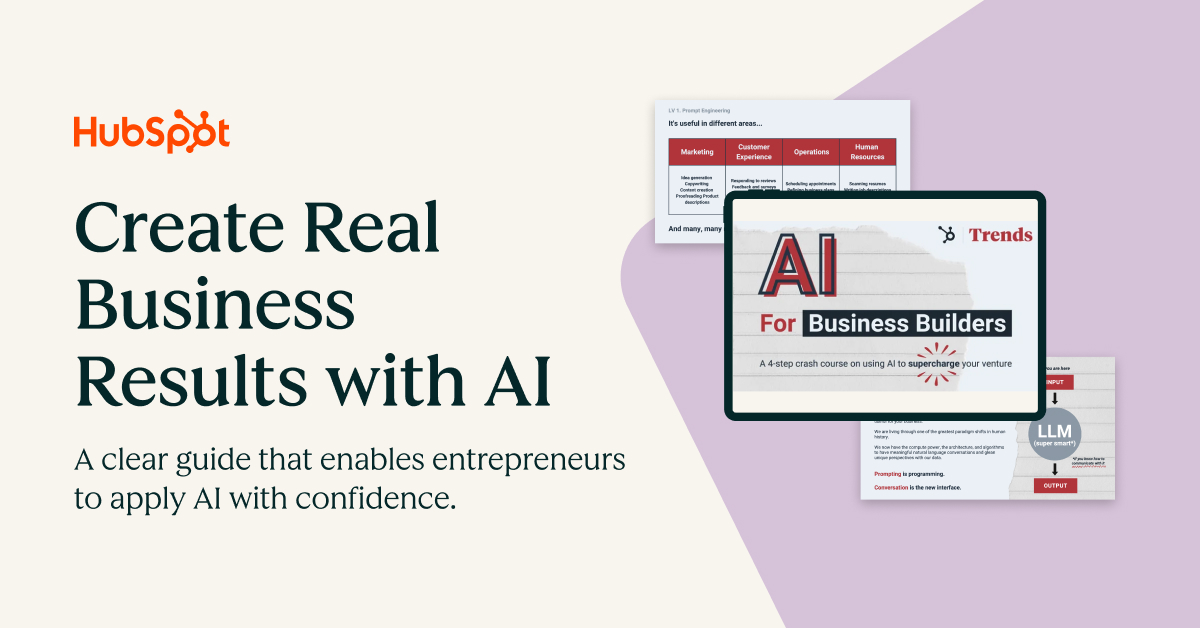
Overwhelmed by AI? HubSpot's free guide cuts through the noise. Get the ultimate crash course for non-technical entrepreneurs who want to harness AI's power—without getting lost in the jargon.
"AI for Business Builders" delivers:
• A 4-part roadmap to AI mastery
• Jargon-free explanations of large language models
• Practical prompt engineering tips you can use today
• Real-world examples of AI boosting businesses like yours
Arm yourself with the knowledge to make informed AI investments and skyrocket your startup's growth.
Download Your Free Guide Now
If you think your colleagues and friends would find this content valuable, we’d love it if you shared our newsletter with them!
That’s it!
Keep innovating and stay inspired!
Erwin
Disclaimer: The "Tiny Big Spark" newsletter is for informational and educational purposes only, not a substitute for professional advice, including financial, legal, medical, or technical. We strive for accuracy but make no guarantees about the completeness or reliability of the information provided. Any reliance on this information is at your own risk. The views expressed are those of the authors and do not reflect any organization's official position. This newsletter may link to external sites we don't control; we do not endorse their content. We are not liable for any losses or damages from using this information.