Sponsored by

When Intelligence Becomes the Biggest Line Item
Artificial intelligence is often described as a tool that saves time, increases productivity, and reduces operational costs. While that remains true in many situations, a new reality is quietly emerging behind the scenes: using advanced AI is becoming one of the largest operating expenses for companies building with it.
For years, payroll has been considered the biggest investment for technology teams. Today, that assumption is being challenged. Some AI-first organizations are now spending significantly more on computing power than on the people writing the software itself. It's a reminder that artificial intelligence doesn't run on ideas alone—it runs on enormous amounts of computing infrastructure.
Live Webinar: SSP Automation, Native to Your Billing Platform

Most finance teams still track SSP in spreadsheets — manually updated, disconnected from billing. On July 22, Tabs' product and marketing leads show what changes when SSP runs natively inside your billing platform: built from real billing data, connected to your Product Catalog, and generating audit-ready documentation automatically.
You'll leave with a clear view of how SSP and billing connect, what transaction price allocation looks like under ASC 606 in practice, and what it takes to close faster without reconciling SSP to contracts by hand.
July 22, 2026 · 1:30–2:00 PM EDT · Live + recording
Register now to save your spot, or read more about how Product Catalog powers billing automation.
Every prompt, every generated image, every automated workflow, and every AI agent relies on specialized processors working continuously inside data centers. As organizations ask AI to perform increasingly complex tasks, the amount of computation—and the cost required to support it—continues to rise.
The conversation is no longer simply about adopting AI. It's about understanding the hidden resources required to keep it running efficiently.
Tip: When evaluating any AI solution, consider not only what it can do but also what it requires to operate consistently over time.
The Hidden Cost Behind Every AI Response
Many people assume AI costs are limited to monthly subscriptions or software licenses. In reality, the largest expense often comes from computation itself.
Modern AI models process billions of calculations in seconds. More advanced systems perform multiple reasoning steps, retrieve external information, call software tools, and generate detailed responses—all of which consume additional computing resources.
Simple chatbot interactions may require relatively little processing power, but agent-based AI systems that perform multi-step reasoning or automate complex workflows consume substantially more.
Industry forecasts also suggest that AI usage will continue expanding rapidly over the next several years. As organizations deploy AI into customer support, software development, research, healthcare, and business operations, computing demand is expected to grow alongside adoption.
This means organizations are beginning to view computing power as a strategic resource rather than an invisible utility operating in the background.
Tip: More capable AI often requires more computation. Efficiency becomes just as important as intelligence.
Wall Street's Scared—You Should Be Buying
Markets are down, but smart money is circling.
In under 5 minutes, you’ll discover three battered but fundamentally strong picks with massive upside as conditions normalize.
These aren’t flavor-of-the-month names. They're backed by long-term trends, strong leadership, and ideal entry points created by panic selling.
The dip is real. The opportunity is rare. With AI, cyclical rebounds, and broad exposure, this report gives you an actionable edge. Get in before Wall Street catches on.
Download the FREE report and position yourself for the rebound.
Why Smarter AI Doesn't Always Mean Cheaper AI
One common assumption is that advances in AI will automatically lower costs. While computing prices have fallen dramatically over time, demand has grown even faster.
New AI systems no longer generate only text. They analyze documents, write code, search databases, coordinate software tools, process images, and complete multi-step tasks independently. Each additional capability increases the amount of computation required.
Fortunately, technology is evolving in both directions. More efficient AI models, open-source alternatives, and smarter deployment strategies continue reducing costs for many workloads.
Organizations are also becoming more selective about where AI creates the greatest value. Instead of applying it everywhere, many teams now focus on high-impact tasks where automation genuinely improves speed, quality, or decision-making.
The goal is no longer maximizing AI usage. The goal is maximizing useful outcomes while keeping computing demands manageable.
Tip: The most effective AI strategy isn't about using AI more often—it's about using it where it delivers meaningful results.

Not just another AI newsletter. MavSource aggregates updates from all major AI newsletters, podcasts, company news, AI labs, and hundreds of other sources — then summarizes what matters, analyzes emerging trends, and adds founder commentary. One 5-minute daily email. Free.

Building AI Responsibly Means Balancing Performance and Cost
As AI becomes part of everyday operations, organizations face a balancing act between innovation and sustainability.
Powerful models offer remarkable capabilities, but every additional request contributes to infrastructure costs, energy consumption, and hardware demand.
This reality is encouraging teams to design smarter AI systems. Better prompts, cleaner datasets, optimized workflows, and carefully selected models all reduce unnecessary computation without sacrificing quality.
Rather than relying exclusively on the largest available model, many organizations combine different AI systems depending on the complexity of the task. Smaller models handle routine work, while larger models are reserved for situations requiring deeper reasoning.
This layered approach improves efficiency while helping organizations manage long-term operating costs.
Tip: Choosing the right AI model for each task often delivers better results than always choosing the most powerful one.
Demystify AI for Your Business in Just 4 Steps
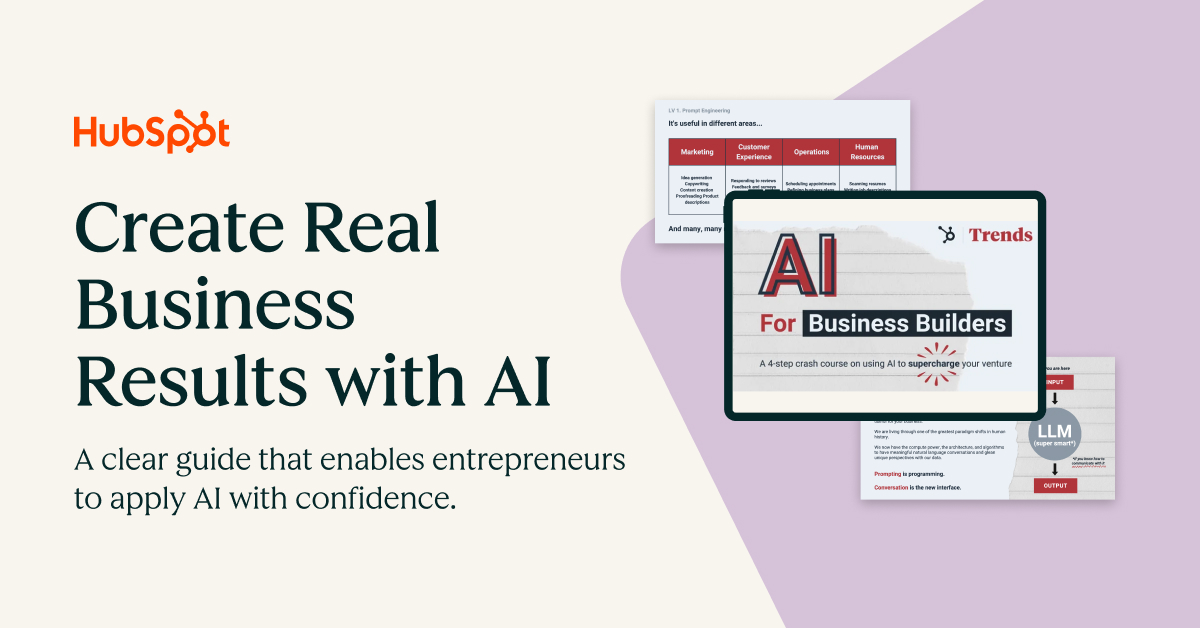
Overwhelmed by AI? HubSpot's free guide cuts through the noise. Get the ultimate crash course for non-technical entrepreneurs who want to harness AI's power—without getting lost in the jargon.
"AI for Business Builders" delivers:
• A 4-part roadmap to AI mastery
• Jargon-free explanations of large language models
• Practical prompt engineering tips you can use today
• Real-world examples of AI boosting businesses like yours
Arm yourself with the knowledge to make informed AI investments and skyrocket your startup's growth.
Download Your Free Guide Now
The Future of AI Will Reward Thoughtful Design
Artificial intelligence continues to evolve at an extraordinary pace, but its future will depend on more than model performance alone.
Success will increasingly be measured by how intelligently AI systems are designed, deployed, and maintained. Organizations that understand both the opportunities and the operational realities behind AI will be better positioned to scale responsibly.
The real challenge isn't simply making AI smarter. It's making AI efficient enough to deliver consistent value without allowing infrastructure demands to outpace practical benefits.
As AI becomes woven into more industries and everyday workflows, one thing becomes increasingly clear: the strongest AI systems won't necessarily be the biggest or the most expensive. They'll be the ones built with careful planning, balanced resource management, and a clear understanding of when intelligence truly creates value.
Tip: Sustainable AI isn't about using the most powerful technology available—it's about building systems that remain effective, efficient, and practical over time.
What’s your next spark? A new platform engineering skill? A bold pitch? A team ready to rise? Share your ideas or challenges at Tiny Big Spark. Let’s build your pyramid—together.
That’s it!
Keep innovating and stay inspired!
If you think your colleagues and friends would find this content valuable, we’d love it if you shared our newsletter with them!
PROMO CONTENT
Can email newsletters make money?
As the world becomes increasingly digital, this question will be on the minds of millions of people seeking new income streams in 2026.
The answer is—Absolutely!

That’s it for this episode!
Thank you for taking the time to read today’s email! Your support allows me to send out this newsletter for free every day.
What do you think for today’s episode? Please provide your feedback in the poll below.
How would you rate today's newsletter?
Share the newsletter with your friends and colleagues if you find it valuable.
Disclaimer: The "Tiny Big Spark" newsletter is for informational and educational purposes only, not a substitute for professional advice, including financial, legal, medical, or technical. We strive for accuracy but make no guarantees about the completeness or reliability of the information provided. Any reliance on this information is at your own risk. The views expressed are those of the authors and do not reflect any organization's official position. This newsletter may link to external sites we don't control; we do not endorse their content. We are not liable for any losses or damages from using this information.