In partnership with

Less Meetings, More Building: Why Small Teams Are Winning Again in the Age of AI
Growth has long been considered the hallmark of success. More people, more departments, more meetings, and more approval layers often signal that an organization is expanding. But growth has a hidden cost that many teams don't notice until it begins slowing everything down.
As organizations become larger, simple decisions start requiring multiple approvals. Projects move through several teams before any meaningful work begins. Ideas spend weeks in discussions instead of reaching customers. Over time, the very structure designed to support growth can become the biggest obstacle to innovation.
Artificial intelligence is now challenging that pattern.
Your growth team woke up to a briefing they didn't ask for.

Monday 7am. Three messages in #growth.
Stripe revenue by channel, Meta and Google spend reconciled against GA4, Klaviyo flow performance, Shopify AOV by source. Posted by Viktor at 6am.
The campaign brief he wrote sits in #campaigns. Brand monitoring scrape runs every six hours. Competitor pricing update lands every Friday.
Your media buyer, content lead, and CMO open Slack to the same prepared room. 3,000+ integrations including every ad platform, CDP, and CMS you run.
"Viktor is like the most capable all-round colleague you can imagine." Sam, CEO, Givr.
Rather than encouraging larger teams to manage increasing workloads, AI is making it possible for smaller, highly empowered groups to accomplish far more than before. The result isn't just faster product development—it's a return to a way of working where ownership, speed, and experimentation become the foundation once again.
Tip: If a simple decision requires several meetings before anyone starts working, the process—not the people—may be slowing progress.
Small Teams Move Faster Because Ownership Is Clear
One of the most enduring ideas behind high-performing teams is surprisingly simple: keep them small enough that everyone understands both the goal and their role in achieving it.
When fewer people share responsibility, communication becomes more direct. Decisions happen closer to the work instead of traveling through multiple layers of management. Every team member develops a stronger understanding of how individual contributions affect the final outcome.
This creates something that is difficult to achieve in large organizations—true ownership.
Ownership means more than completing assigned tasks. It means feeling responsible for the quality of the final product, solving problems without waiting for someone else to act, and continuously improving what has already been built.
Small teams also become more willing to experiment because the cost of making reversible decisions is relatively low. Instead of waiting for perfect certainty, they test ideas, gather feedback, learn quickly, and improve through iteration.
In today's AI-driven environment, that speed has become an even greater advantage.
Tip: Encourage decision-making at the team level whenever possible. Fast learning often comes from making small, reversible decisions instead of waiting for perfect certainty.
12 Surprising Money Mistakes Even Smart People Make

You’re smart about saving money, like shopping clearance racks, limiting eating out, and choosing affordable streaming services. However, there are still some cost-cutting tips you might not know yet. Once you discover these, you could quickly find extra cash in your pocket.
Learn More
AI Is Changing How Ideas Become Reality
For years, bringing a product to life usually followed a familiar path.
Ideas were discussed, documented, reviewed, revised, approved, and eventually handed to technical teams for implementation. Writing detailed plans before building anything helped reduce uncertainty because creating software required significant time and resources.
AI-powered development tools are beginning to shorten that timeline dramatically.
Today, a functional prototype can often be created within hours or days rather than weeks or months. Instead of debating whether an idea might work, teams can quickly build an early version, experience it firsthand, identify weaknesses, and refine it based on real interaction.
This doesn't make thoughtful planning less important.
It changes when planning delivers the greatest value.
Experiencing a working prototype often reveals challenges, opportunities, and customer needs that are difficult to predict through documentation alone. Writing after testing frequently produces stronger strategies because those decisions are informed by evidence rather than assumptions.
The faster teams can move between building, learning, and improving, the faster meaningful innovation takes shape.
Tip: When uncertainty is high, create a simple prototype early. Real-world experience often answers questions that lengthy planning cannot.
Domain Names + Web and Email Hosting You Need

Still paying GoDaddy or Namecheap prices? Porkbun sells most domains at cost for low, transparent registration and renewal pricing with no nonsense. Get free features like WHOIS privacy and SSL certificates, plus real human support 24/7, 365 days a year. Save $1 on your next domain name now.

Great Products Are Built by People Who Use Them
One of the strongest lessons emerging from modern product development is that the people building a product should experience it regularly.
Using the product every day creates immediate feedback. Small frustrations become impossible to ignore. Missing features become obvious. Opportunities for improvement appear naturally through everyday use instead of waiting for customer complaints.
This creates a culture where improvements happen continuously rather than being postponed until the next development cycle.
Instead of saying, "Someone else will fix that later," teams begin asking, "How can this be better today?"
That mindset strengthens accountability because quality becomes everyone's responsibility rather than belonging to one department.
It also keeps customer experience at the center of development. Every improvement is evaluated based on how it actually feels to use the product—not simply whether it functions correctly.
Building something useful requires more than technical excellence. It requires empathy for the people who will rely on it every day.
Tip: Regularly use the products or services you help create. Firsthand experience often reveals improvements that reports and metrics cannot fully capture.
100+ ChatGPT Prompts to Revolutionize Your Day
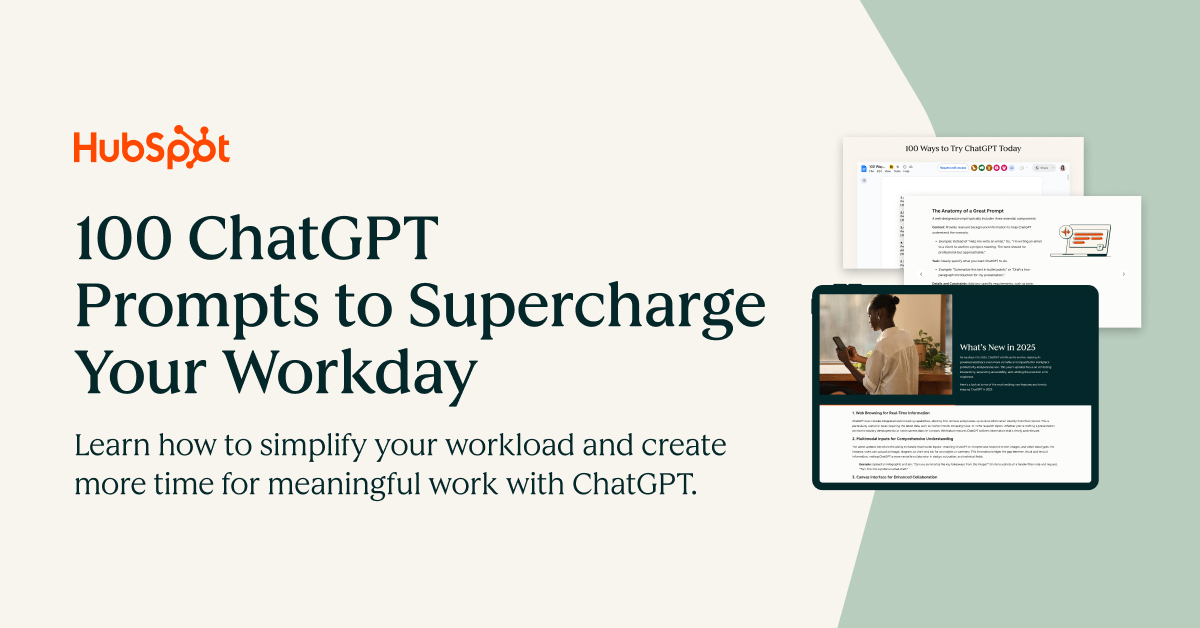
Supercharge your productivity with HubSpot's comprehensive guide. This free resource is your fast track to AI mastery:
• Industry-Specific Use Cases: 15+ real-world applications across various sectors
• Productivity Guide: 21 best practices to 10x your efficiency with AI
• Prompt Powerhouse: 100+ ready-to-use prompts for immediate implementation
• Challenge Buster: Overcome common AI hurdles with expert strategies
Plus, in-depth sections on email composition, content creation, customer support, and data analysis.
Find Your Guide Here
Writing Still Matters—But Experience Makes It Stronger
Despite AI accelerating software development, one practice remains as valuable as ever: clear thinking through writing.
Writing forces ideas to become specific.
It exposes unclear assumptions, highlights missing details, and creates a shared understanding that teams can build upon. Strong documentation remains essential for aligning goals, communicating direction, and preserving knowledge.
What has changed is the sequence.
Instead of relying only on imagination before creating something, teams can now build an early version first, interact with it, and then document what they've genuinely learned.
This produces richer discussions because the conversation shifts from hypothetical scenarios to observable outcomes.
Ideas become easier to explain when people can see, test, and challenge something tangible.
In many cases, a prototype becomes another way of thinking—not a replacement for thoughtful planning, but a powerful companion to it.
Tip: Use writing to clarify decisions, but whenever possible, support those decisions with lessons learned from real experimentation rather than assumptions alone.
The Strongest Teams Keep Learning Faster Than They Grow
As successful products expand, organizations naturally become larger.
New responsibilities appear. Additional specialists join. Coordination becomes more complex.
The challenge isn't growth itself.
The challenge is preserving the speed, accountability, and curiosity that existed when the team was smaller.
High-performing organizations accomplish this by maintaining clear ownership, empowering autonomous teams, shortening feedback loops, and encouraging continuous learning instead of unnecessary bureaucracy.
AI makes this approach even more practical by handling repetitive work, accelerating development, and allowing people to focus on solving meaningful problems rather than managing administrative complexity.
Technology alone won't create better teams.
But paired with trust, ownership, and a willingness to learn quickly, it gives smaller groups the ability to achieve results that once required much larger organizations.
Sometimes the biggest competitive advantage isn't having more people.
It's creating an environment where every person has the freedom—and responsibility—to build, improve, and keep moving forward.
Tip: As teams grow, regularly remove unnecessary approvals, repetitive processes, and communication layers. Protecting speed is often just as important as achieving scale.
What’s your next spark? A new platform engineering skill? A bold pitch? A team ready to rise? Share your ideas or challenges at Tiny Big Spark. Let’s build your pyramid—together.
That’s it!
Keep innovating and stay inspired!
If you think your colleagues and friends would find this content valuable, we’d love it if you shared our newsletter with them!
PROMO CONTENT
Can email newsletters make money?
As the world becomes increasingly digital, this question will be on the minds of millions of people seeking new income streams in 2026.
The answer is—Absolutely!

That’s it for this episode!
Thank you for taking the time to read today’s email! Your support allows me to send out this newsletter for free every day.
What do you think for today’s episode? Please provide your feedback in the poll below.
How would you rate today's newsletter?
Share the newsletter with your friends and colleagues if you find it valuable.
Disclaimer: The "Tiny Big Spark" newsletter is for informational and educational purposes only, not a substitute for professional advice, including financial, legal, medical, or technical. We strive for accuracy but make no guarantees about the completeness or reliability of the information provided. Any reliance on this information is at your own risk. The views expressed are those of the authors and do not reflect any organization's official position. This newsletter may link to external sites we don't control; we do not endorse their content. We are not liable for any losses or damages from using this information.