In partnership with

Stop Designing Straight Lines: Why the Future of AI Depends on Smarter Systems, Not Bigger Models
Most people picture AI as something that answers questions, writes emails, or summarizes documents. Useful? Absolutely. But that is only scratching the surface.
The real transformation is happening behind the scenes—not because AI is becoming "smarter," but because it is learning how to work.
For years, organizations have relied on fixed workflows. Every process was carefully mapped out from beginning to end, assuming each situation would follow the same predictable path. That approach worked when work itself was predictable. Today, it rarely is.
Think about how real life actually unfolds. No two customer requests are identical. No two business problems arrive neatly packaged. Every situation comes with different information, different priorities, and unexpected twists. Trying to force every scenario into the same sequence often creates unnecessary delays, inefficiencies, and poor decisions.
Your growth team woke up to a briefing they didn't ask for.

Monday 7am. Three messages in #growth.
Stripe revenue by channel, Meta and Google spend reconciled against GA4, Klaviyo flow performance, Shopify AOV by source. Posted by Viktor at 6am.
The campaign brief he wrote sits in #campaigns. Brand monitoring scrape runs every six hours. Competitor pricing update lands every Friday.
Your media buyer, content lead, and CMO open Slack to the same prepared room. 3,000+ integrations including every ad platform, CDP, and CMS you run.
"Viktor is like the most capable all-round colleague you can imagine." Sam, CEO, Givr.
That is exactly where agentic AI changes the conversation.
Instead of following one rigid script, AI agents can understand a situation, decide what needs to happen next, complete the necessary tasks, evaluate the results, and adjust their approach until the goal is achieved. Rather than asking, "What is Step 3?" these systems ask, "What should happen next based on everything that is happening right now?"
Tip: Instead of viewing AI as a tool that replaces individual tasks, think of it as a system that coordinates work. The greatest value often comes from improving how decisions flow, not simply automating one activity.
Demystify AI for Your Business in Just 4 Steps
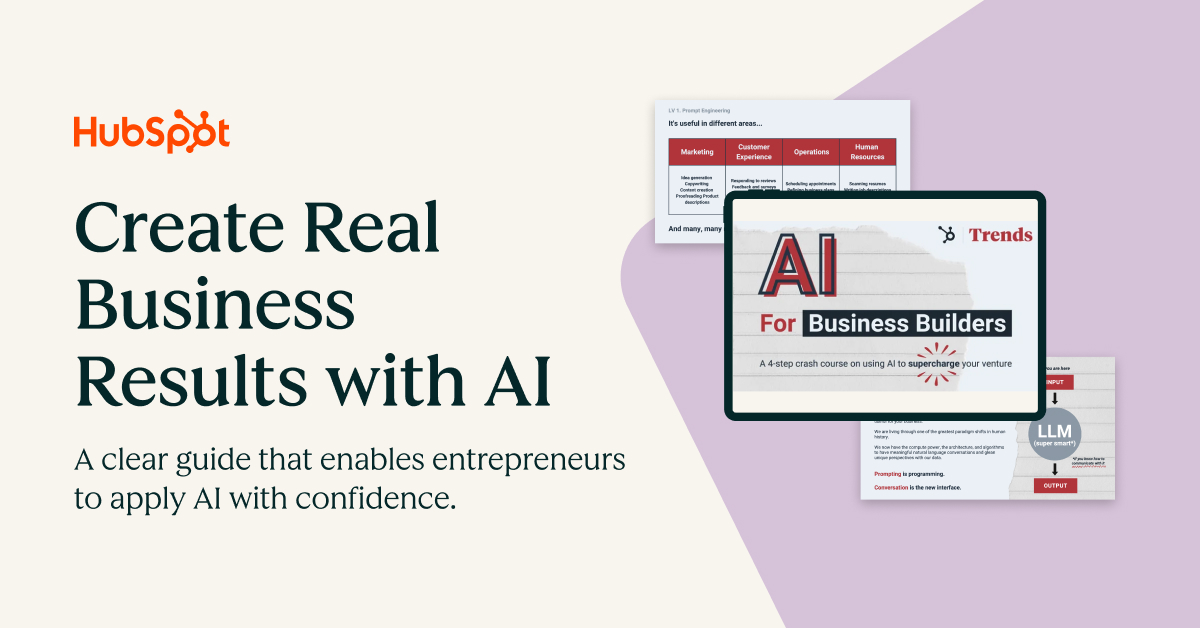
Overwhelmed by AI? HubSpot's free guide cuts through the noise. Get the ultimate crash course for non-technical entrepreneurs who want to harness AI's power—without getting lost in the jargon.
"AI for Business Builders" delivers:
• A 4-part roadmap to AI mastery
• Jargon-free explanations of large language models
• Practical prompt engineering tips you can use today
• Real-world examples of AI boosting businesses like yours
Arm yourself with the knowledge to make informed AI investments and skyrocket your startup's growth.
Download Your Free Guide Now
AI That Doesn't Just Think—It Acts
Large language models have become familiar because they can understand language, organize messy information, and generate useful responses. But understanding alone does not solve problems.
What makes an AI agent different is the ability to turn reasoning into action.
An AI agent combines several capabilities into one continuous cycle. It interprets information, creates a plan, connects with software tools, carries out tasks, remembers important context, reviews the results, and adapts if something changes. This process repeats until the objective is complete.
Memory plays an important role here. Instead of treating every interaction as brand new, an AI agent can retain relevant context throughout a task. That means decisions become more consistent because they build upon previous information instead of starting from scratch every time.
Even more importantly, AI agents do not work in isolation. They can connect with databases, search engines, cloud applications, document repositories, communication platforms, and other software through APIs. This allows them to move beyond generating ideas and begin executing real work.
Tip: When evaluating AI solutions, ask one important question: Can it actually complete the task, or does it only generate recommendations? The difference between suggesting work and finishing work is significant.
One AI Agent Is Helpful. A Team of AI Agents Is Transformational.
Imagine assigning every responsibility to a single employee, regardless of expertise. It would quickly become overwhelming.
The same principle applies to AI.
Instead of relying on one agent to handle everything, organizations are beginning to create teams of specialized AI agents. Each one focuses on a particular responsibility while collaborating toward a shared outcome.
One agent may analyze documents. Another validates policies. Another identifies unusual patterns. Another communicates with customers. An orchestrator agent oversees the entire process, assigning work where it belongs and bringing every result together.
The sequence is not fixed.
Sometimes several tasks happen simultaneously because they are independent. Other times, one result determines the next action. If new information appears or something is missing, the system simply adjusts without forcing everything back into a rigid process.
This flexibility allows work to match reality rather than forcing reality to fit a flowchart.
Tip: Specialization often yields better results than trying to build a single AI system that does everything. Smaller, focused agents working together are usually more adaptable and easier to improve over time.
Introducing The First Agentic CRM

Get revenue agents, workflows, and automations across every stage of your motion. Access customer data in real time through Attio's web app, MCP, API, and SDK.
Then Ask Attio anything about your business and get instant answers.
It's the CRM that runs the work behind every win.

Why Flexibility Matters More Than Perfect Planning
Consider a customer submitting an insurance claim.
The information might include written descriptions, voice recordings, photographs, videos, and supporting documents. Some submissions are complete. Others leave out critical details. Every claim introduces different circumstances.
Traditional workflows struggle because they assume the same order of events every time.
Agentic AI approaches the problem differently.
The system first evaluates what information is available. It sends documents for analysis while simultaneously verifying policy coverage. If unusual activity appears, another specialized agent investigates further. If information is missing, the customer is automatically asked to provide additional details before processing continues.
Nothing follows a predetermined route.
Instead, every decision depends on the context of the specific case.
This dynamic approach reflects how experienced professionals naturally solve problems. They assess the situation first, then decide the best next step instead of blindly following a checklist.
Tip: When designing any process—whether powered by AI or not—focus on building flexibility around changing conditions instead of assuming every situation will unfold the same way.
What if your money could drive itself to your goals?
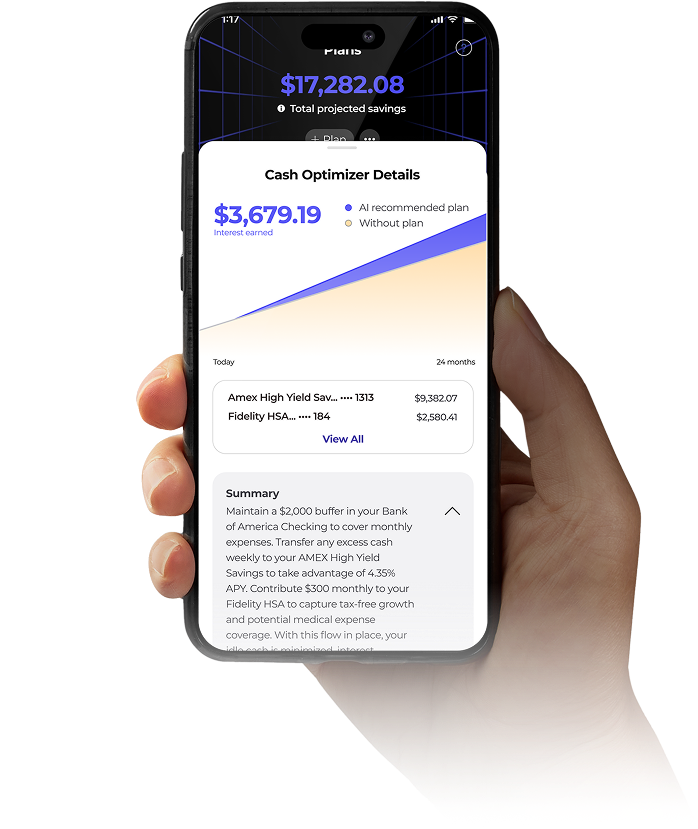
Any bank, any account, Piere makes it possible. In seconds, Piere analyzes your spending, income, wants, and goals, then creates fully automated plans for your money to follow.
- Save money automatically when you get paid — your money moves itself to the right account at the right interest rate
- Repay debt and stay debt free - Piere smartly determines which accounts to pay and when for the biggest impact
- Spend smarter — Piere keeps only the money you need for monthly expenses in your checking, moving the rest to high-yield accounts for safekeeping (and less temptation)
Get started in just seconds, and if you don't grow by at least $120 in your first year, we’ll give you back the difference.
Learn More
The Real Shift Is Not Technology—It's Design Thinking
Perhaps the biggest misconception about AI is believing that better technology automatically creates better outcomes.
In reality, success increasingly depends on designing systems that can adapt responsibly.
Business architecture is evolving from mapping fixed sequences toward defining capabilities, policies, decision boundaries, and governance. Instead of specifying every action in advance, the focus shifts toward establishing what AI is allowed to do, what information it can access, and when human involvement becomes necessary.
This also places greater importance on APIs, system integrations, and data quality because AI agents rely on accurate information and connected tools to perform effectively.
Adaptability without oversight quickly becomes risk.
Organizations therefore need clear guardrails that define responsibilities, permissions, accountability, and escalation points whenever human judgment is required.
The future is not about removing people from decision-making. It is about allowing technology to handle routine complexity while ensuring people remain responsible for oversight, governance, and high-impact decisions.
Tip: Every autonomous system should answer three questions before deployment: What decisions can it make? What actions are off-limits? When should a human step in? Clear boundaries create confidence and reduce unnecessary risk.
AI is no longer just changing how work gets done—it is changing how work is designed.
The organizations that benefit most will not necessarily be the ones with the biggest AI models. They will be the ones that rethink rigid processes, embrace adaptive systems, and establish thoughtful governance from the beginning.
The future belongs less to perfectly planned workflows and more to intelligent systems that know when to adapt, when to collaborate, and when to ask for human guidance.
And perhaps that is the biggest shift of all: success will come not from designing every possible path, but from building systems capable of finding the right one.
What’s your next spark? A new platform engineering skill? A bold pitch? A team ready to rise? Share your ideas or challenges at Tiny Big Spark. Let’s build your pyramid—together.
That’s it!
Keep innovating and stay inspired!
If you think your colleagues and friends would find this content valuable, we’d love it if you shared our newsletter with them!
/
PROMO CONTENT
Can email newsletters make money?
As the world becomes increasingly digital, this question will be on the minds of millions of people seeking new income streams in 2026.
The answer is—Absolutely!

That’s it for this episode!
Thank you for taking the time to read today’s email! Your support allows me to send out this newsletter for free every day.
What do you think for today’s episode? Please provide your feedback in the poll below.
How would you rate today's newsletter?
Share the newsletter with your friends and colleagues if you find it valuable.
Disclaimer: The "Tiny Big Spark" newsletter is for informational and educational purposes only, not a substitute for professional advice, including financial, legal, medical, or technical. We strive for accuracy but make no guarantees about the completeness or reliability of the information provided. Any reliance on this information is at your own risk. The views expressed are those of the authors and do not reflect any organization's official position. This newsletter may link to external sites we don't control; we do not endorse their content. We are not liable for any losses or damages from using this information.